

Understanding Structural Health. Informing Critical Decisions.
You cannot strengthen what you do not understand. Before any rehabilitation, strengthening, or protection work begins, it is essential to have a complete and accurate understanding of the structure’s true condition. Structural evaluation is the critical first step—providing the data, analysis, and insights needed to make informed decisions about repair, rehabilitation, or continued service. At Arabian Strengthening & Protection Co., our structural evaluation services combine advanced diagnostic technologies with experienced engineering analysis to deliver comprehensive assessments of structural health, deterioration mechanisms, and remaining service life. We do not rely on guesswork or superficial observations. Our engineers conduct thorough investigations, identify root causes of deterioration, and provide actionable recommendations that guide cost-effective, long-lasting solutions.

Why Structural Evaluation Matters
Structural evaluation is essential for ensuring safety, optimizing maintenance investments, and extending asset life. It provides safety assurance by identifying hidden deterioration that could compromise structural safety. It enables informed decision-making through data-driven insights for repair, rehabilitation, or replacement decisions. It optimizes costs by enabling targeted repairs, avoiding unnecessary work or premature replacement. It manages risk by identifying vulnerabilities and prioritizing interventions based on consequence of failure. It extends asset life by supporting timely interventions that add decades of service life. And it ensures regulatory compliance by documenting structural condition and adherence to safety standards.
Our Structural Evaluation Methodology
We follow a systematic, multi-stage approach to structural evaluation that ensures thorough assessment and actionable results. The process begins with document review and historical analysis, where we examine design drawings, construction records, maintenance history, previous evaluations, and service history to understand the structure’s background and evolution. We then conduct visual inspection and distress mapping, systematically documenting visible distress including cracking patterns, spalling and delamination, staining and efflorescence, settlement and movement, corrosion evidence, and the condition of previous repairs. This initial assessment helps us develop hypotheses about deterioration mechanisms that guide further testing.
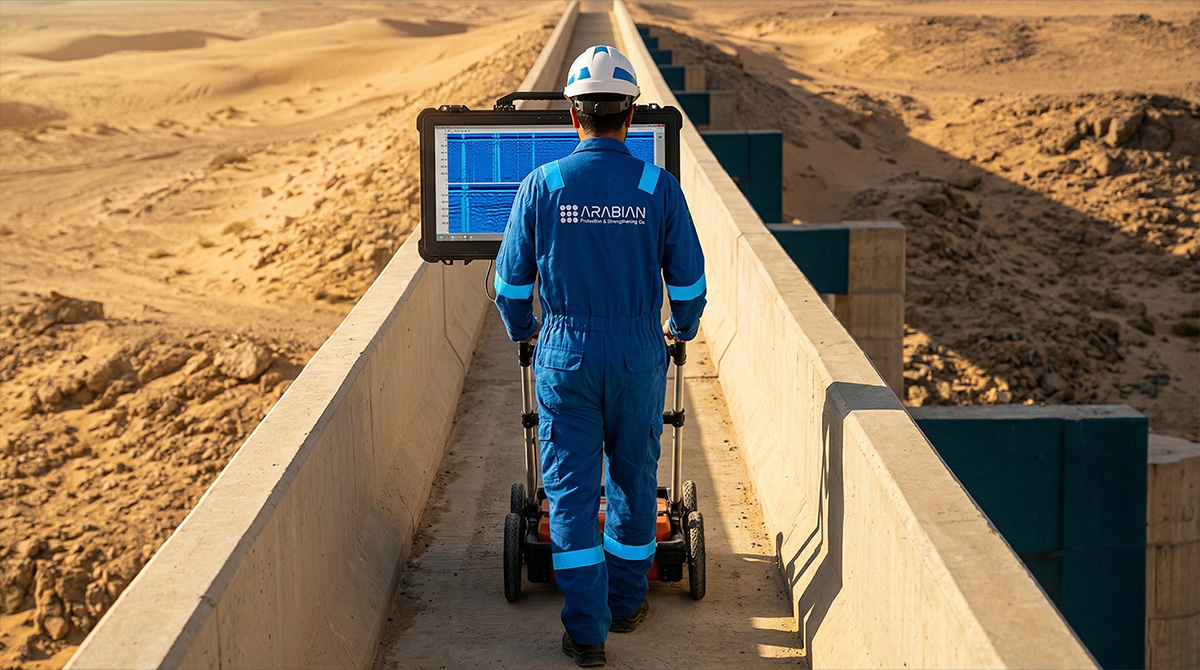
Non-destructive testing forms the core of our evaluation methodology, providing detailed data on internal conditions without damaging the structure. We employ rebound hammer testing to evaluate concrete surface hardness and estimate compressive strength, identifying variations in quality and potential deterioration zones. Ultrasonic pulse velocity measures the speed of sound waves through concrete to assess uniformity and detect internal voids, cracks, and honeycombing. Ground-penetrating radar reveals rebar location and cover depth, post-tensioning tendon positions, subsurface defects, and concrete thickness.
Half-cell potential mapping evaluates corrosion risk by measuring the electrochemical potential of reinforcement, identifying areas of active corrosion versus passive zones. Impact-echo testing detects internal flaws, delamination, and measures thickness using stress waves. Thermal imaging reveals surface temperature variations that indicate moisture intrusion, delamination, and insulation defects.
Where required, we extract samples for laboratory testing to provide detailed material characterization. Chloride content analysis measures chloride concentration at various depths, assessing corrosion risk. Carbonation depth measurement determines the depth of carbonation front and loss of alkalinity. Compressive strength testing evaluates concrete strength from core samples. Petrographic examination reveals microstructure, aggregate characteristics, ASR, and sulfate attack. Chemical analysis identifies sulfate content, alkali content, and the presence of deleterious materials.
Using field data and testing results, our engineers perform structural analysis and load capacity assessment. Load rating determines structural capacity for current and future loads. Code compliance verification ensures structures meet Saudi Building Code and applicable standards. Remaining service life estimation projects deterioration progression and useful remaining life. Deflection and cracking analysis evaluates serviceability performance. Dynamic analysis assesses vibration and seismic performance where applicable.
Finally, we deliver comprehensive reports that translate technical data into actionable insights. Our reports include an executive summary with concise overview of findings and recommendations, background and scope documentation, field observations with photographs, NDT and testing results with analysis, structural analysis and capacity assessment, conclusions on structural condition and deterioration mechanisms, and prioritized recommendations for repair, strengthening, or monitoring.e reinforcement and measure cover depth, half-cell potential mapping to assess corrosion risk, rebound hammer to evaluate concrete strength, ultrasonic pulse velocity to detect internal flaws, and impact-echo to identify delamination. Laboratory testing provides critical data on chloride content, carbonation depth, and petrographic characteristics. Structural analysis determines remaining capacity and required restoration.
Based on assessment findings, our engineers develop a comprehensive repair specification that addresses material selection—choosing compatible repair mortars based on exposure, structural requirements, and application method. We incorporate corrosion mitigation strategies including inhibitors, anti-corrosion coatings, or integration with cathodic protection where required. We evaluate structural considerations including load transfer, reinforcement detailing, and temporary shoring needs, and address aesthetic requirements to match texture, color, and finish for architectural concrete.
Proper surface preparation is the single most critical factor in repair durability. We employ hydro-demolition to remove deteriorated concrete with high-pressure water, mechanical chipping for precision removal, and abrasive blasting to clean surfaces and achieve the required surface profile for bonding. We expose reinforcement to at least 180 degrees for proper cleaning and coating, ensuring that all corrosion products are removed to bright metal.
Corrosion-damaged reinforcement must be treated to prevent recurrence. We clean reinforcement to bright metal using abrasive blasting or mechanical methods. Where section loss exceeds allowable limits, we splice or replace severely corroded reinforcement. We apply anti-corrosion coatings or corrosion inhibitors to protect the cleaned steel, and add supplemental reinforcement where required for structural restoration.
We apply repair materials using techniques matched to the application. Hand application provides flexibility and accessibility for small patches and vertical or overhead repairs. Sprayed shotcrete or gunite offers high production rates and excellent bonding for large-area repairs and structural sections. Form-and-pour provides precise geometry and controlled placement for deep sections and structural elements. Injection offers minimally invasive sealing for cracks and voids.
Proper curing is essential to achieve design strength, durability, and shrinkage control. We employ moist curing using wet burlap, curing compounds, or plastic sheeting, with temperature control for hot or cold weather applications and surface protection during the curing period. Where required, we apply surface finishes, sealers, or protective coatings to enhance durability and aesthetics.
Key Structural Evaluation Services
Condition assessment provides comprehensive evaluation of structural health, identifying deterioration and determining appropriate interventions—essential for pre-purchase due diligence, pre-rehabilitation baseline assessment, post-construction quality verification, and periodic condition monitoring. Corrosion assessment specializes in evaluating reinforcement corrosion risk through chloride analysis, carbonation depth measurement, and half-cell potential mapping—critical for parking structures, coastal facilities, and aging infrastructure. Load capacity analysis determines safe load capacity for current and future demands, essential for changes in occupancy, addition of heavy equipment, or expansion projects. Durability studies project remaining service life based on material properties and environmental exposure, supporting asset management and capital planning. Forensic investigation provides root-cause analysis of structural failures or premature deterioration, determining underlying causes and appropriate remedies. Monitoring programs provide ongoing tracking of crack movement, settlement, and corrosion activity for structures requiring continuous observation.
Applications Across Structure Types
Our structural evaluation expertise spans all major structure types. For bridges and viaducts, we assess deck condition, bearing movement, substructure stability, and scour. For parking structures, we evaluate overhead slab delamination, corrosion activity, and joint performance. For buildings, we assess facade condition, foundation settlement, and structural system integrity. For industrial facilities, we evaluate equipment foundation condition, heavy load effects, and chemical attack. For water and wastewater structures, we assess watertightness, chemical resistance, and biological attack. For marine structures, we evaluate tidal zone deterioration, chloride ingress, and scour. For heritage structures, we focus on material characterization, structural behavior, and sensitive intervention planning.
Why Choose Arabian Strengthening & Protection Co. for Structural Evaluation
Clients choose Arabian Strengthening & Protection Co. for our advanced technology, experienced engineers, comprehensive approach, root-cause focus, actionable recommendations, and integrated solutions. We employ state-of-the-art NDT equipment that provides accurate, reliable data. Our qualified structural engineers bring deep diagnostic expertise to every project. Our multi-stage methodology covers all aspects of structural health. We identify underlying deterioration mechanisms, not just symptoms. Our reports provide clear, prioritized guidance for repair and rehabilitation. And we offer seamless transition from evaluation to design to execution, ensuring that assessment findings translate directly into effective solutions.
