

Protecting Lives. Safeguarding Assets. Ensuring Safety.
Fire is one of the most devastating threats to any structure—endangering lives, destroying assets, and disrupting operations. In a fraction of a moment, fire can undo years of investment, threaten everything that matters, and leave devastation in its wake. In the Kingdom of Saudi Arabia, where buildings of all types house the people, businesses, and assets that drive national prosperity, the importance of reliable fire protection cannot be overstated. At Arabian Strengthening & Protection Co., we understand that fire safety is not just a regulatory requirement—it is a moral imperative. We design, supply, install, and commission comprehensive fire protection and alarm systems that detect fires early, alert occupants, control the spread of fire, and suppress flames effectively. From residential buildings and commercial complexes to industrial facilities and critical infrastructure, we deliver fire safety solutions that meet the highest standards of reliability, performance, and code compliance. Our systems are designed to protect what matters most—lives, assets, and continuity.
Why Fire Protection Matters
Fire safety is fundamental to building design, occupant safety, and asset protection. Life safety is the highest priority—early detection and warning give occupants time to evacuate safely before conditions become dangerous. Asset protection is essential—fire suppression systems minimize damage to property, equipment, and inventory, preserving the investments that buildings represent. Operational continuity is critical—effective fire protection reduces downtime and business interruption, allowing organizations to resume normal operations quickly after an incident. Regulatory compliance is mandatory—all buildings must meet Saudi Civil Defense and NFPA requirements, with penalties for non-compliance including fines, closure, and liability. Insurance requirements are significant—proper fire protection systems are essential for adequate insurance coverage, with many insurers requiring specific systems for coverage and offering premium reductions for well-protected facilities. Without comprehensive fire protection, structures and their occupants are vulnerable to catastrophic loss. Our systems provide the protection needed to prevent tragedy.
Fire Alarm Systems
Fire alarm systems are the first line of defense—detecting fire at its earliest stages and alerting occupants and emergency responders. We design and install comprehensive fire alarm systems tailored to each facility’s unique requirements.
Addressable fire alarm panels represent the highest level of detection technology. Unlike conventional systems that identify only the zone of an alarm, addressable panels identify the exact location of each device—detector, call point, or module—allowing responders to go directly to the source of the alarm. These intelligent panels also provide device status information, indicating when detectors need cleaning or are approaching the end of their service life. We select panels with capacity for future expansion, ensuring that the system can grow with the facility.
Smoke detectors provide early warning of fire, sensing smoke particles before flames develop. We select detector types based on application—photoelectric detectors for smoldering fires common in residential and office settings, ionization detectors for fast-flaming fires, and multi-sensor detectors that combine technologies for improved reliability. We locate detectors based on ceiling configuration, air movement, and the specific hazards of each area.
Heat detectors provide protection where smoke detectors are unsuitable—kitchens where cooking smoke would cause false alarms, garages where exhaust fumes are present, and dusty industrial environments. We provide fixed-temperature detectors that alarm when a specific temperature is reached and rate-of-rise detectors that alarm when temperature increases rapidly.
Flame detectors provide rapid response for high-hazard areas where fire could develop quickly. Ultraviolet detectors sense the UV radiation emitted by flames, while infrared detectors sense the flicker of flame. We use these detectors in aircraft hangars, fuel storage areas, and other facilities where rapid fire growth is possible.
Manual call points allow occupants to activate the alarm manually. We locate call points at building exits and strategic locations throughout the facility, ensuring they are visible and accessible. Each call point is addressable, allowing the panel to identify its exact location.
Audible and visual alarms ensure that all occupants receive notification. We provide horns and speakers for audible notification, strobes for visual notification for hearing-impaired occupants, and voice evacuation systems that provide clear, intelligible instructions for safe evacuation.
Gas detection systems monitor for combustible and toxic gases in industrial applications. We install sensors that detect gas accumulation before it reaches dangerous concentrations, initiating alarms and, where required, activating ventilation systems to clear the hazard.
Sprinkler Systems
Sprinkler systems are the most widely used fire suppression systems—providing automatic protection that activates when fire is detected, controlling or extinguishing flames before they spread. We design and install sprinkler systems tailored to each facility’s occupancy and hazard classification.
Wet pipe systems are the most common type, with water-filled pipes that discharge immediately when sprinklers activate. These systems are ideal for heated buildings where freezing is not a concern—office buildings, residential facilities, and commercial spaces. Dry pipe systems use air-filled pipes that release water when sprinklers open, used in unheated buildings where freezing could damage wet systems—parking structures, cold storage facilities, and unheated warehouses.
Pre-action systems require both detection and sprinkler activation before water is released, used in facilities where accidental discharge could cause significant damage—data centers, museums, libraries, and telecommunications facilities. Deluge systems have open sprinklers that discharge water simultaneously when detection activates, used in high-hazard areas where rapid fire spread is possible—aircraft hangars, flammable liquid storage, and chemical processing areas. Foam-water systems combine foam and water for flammable liquid fires in aircraft hangars, fuel storage areas, and industrial facilities where hydrocarbon fires are a risk.
Fire Pumps & Water Supplies
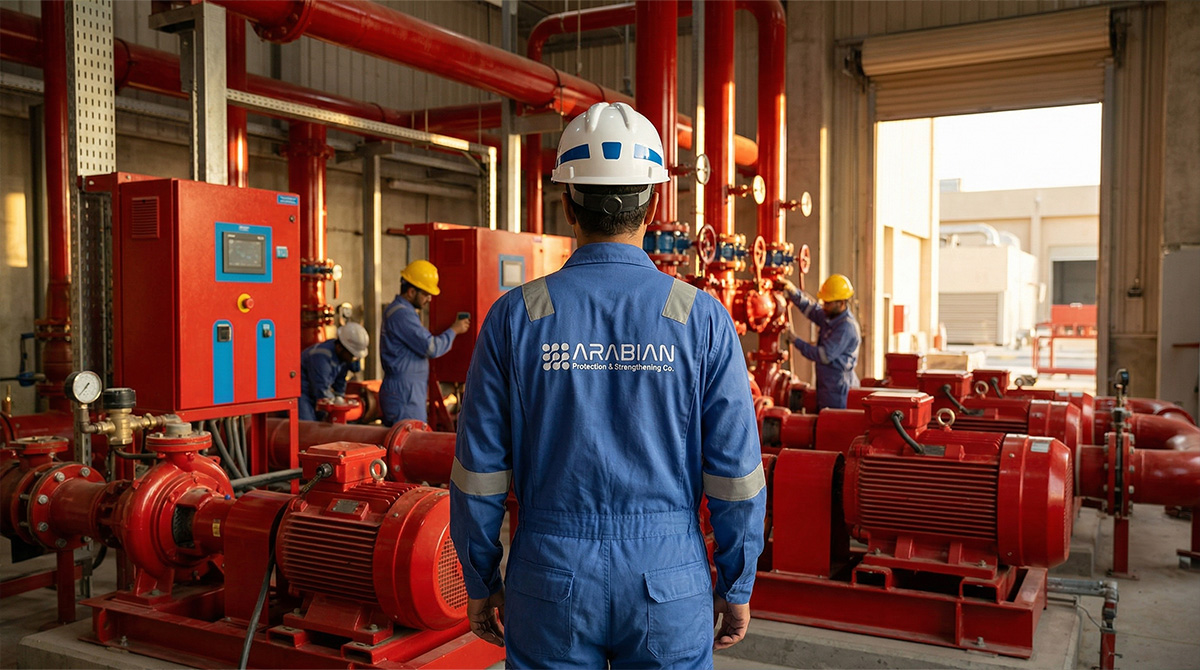
Fire pumps ensure that sprinkler systems and standpipes receive adequate water pressure and flow to perform effectively. We supply and install complete fire pump systems that provide the water supply essential to fire protection.
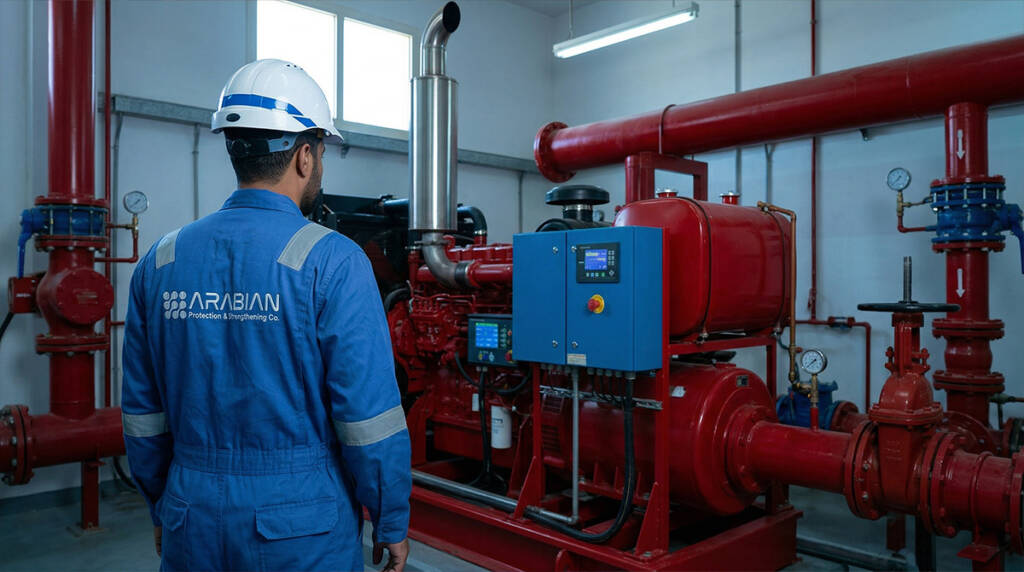
Electric fire pumps are the most common type, powered by dedicated electrical supply with automatic transfer switches that connect to emergency power. We select pumps with capacity matched to the system demand, with controllers that provide manual and automatic operation. Diesel fire pumps provide protection where electrical reliability is a concern. These engine-driven pumps are self-contained, requiring only fuel supply and battery power for starting. We install diesel pumps with day tanks for fuel storage and controllers that provide automatic start on system pressure drop.
Jockey pumps maintain system pressure, preventing unnecessary main pump starts. These small pumps cycle on and off to maintain pressure, ensuring that when a sprinkler activates, the system pressure drop is sufficient to start the main pump. Water storage tanks provide on-site water where municipal supply is inadequate or where reliability is a concern. We install ground storage or elevated tanks sized to provide the required flow and duration for the fire protection system.
Standpipe Systems
Standpipe systems provide fire hoses and water supply throughout buildings, enabling firefighters to respond quickly and effectively. We design and install standpipe systems for high-rise buildings, large facilities, and structures where fire department access is limited.
Class I standpipes provide 2.5-inch connections for fire department use, with hose valves located in stairwells and throughout the building. These systems are designed to supply the large volumes of water that fire department operations require. Class II standpipes provide 1.5-inch connections with pre-connected hoses for occupant use, designed for trained building occupants to use in the early stages of fire. Class III standpipes combine both features, providing comprehensive protection for large buildings.
Special Hazard Systems
Certain facilities and assets require specialized fire suppression systems designed for unique hazards. We provide a full range of special hazard systems for the most demanding applications.
Clean agent systems use gaseous agents—FM-200, Novec 1230, or similar—that suppress fire without damaging sensitive equipment. These systems are ideal for data centers, server rooms, telecommunications facilities, control rooms, and other areas where water would cause unacceptable damage. The agents extinguish fire by interrupting the combustion reaction, then dissipate without residue, leaving no cleanup and no damage to sensitive electronics.
Carbon dioxide systems use high-pressure CO₂ that displaces oxygen, extinguishing fire quickly. These systems are used in industrial equipment, machinery spaces, and flammable liquid storage areas where the hazard requires rapid suppression and where personnel are not normally present. Foam systems use aqueous film-forming foam to suppress flammable liquid fires in aircraft hangars, fuel storage, refineries, and chemical facilities where hydrocarbon fuels create a risk of rapid fire spread.
Dry chemical systems use powder agents to suppress flammable liquid and electrical fires in kitchens, industrial equipment, and hazardous areas where rapid knockdown is required. Kitchen hood systems use wet chemical agents specifically designed for commercial cooking fires in restaurant kitchens, commercial food service facilities, and institutional kitchens, protecting the cooking equipment and exhaust systems where grease fires are a hazard.
Passive Fire Protection
Passive fire protection systems prevent the spread of fire and smoke, providing critical time for evacuation and limiting damage. These systems are built into the structure, providing protection that is always active.
Fire-rated construction includes fire-rated walls, floors, and doors that compartmentalize fire, containing it to the area of origin. We ensure that fire-rated assemblies are properly constructed and maintained, with the required fire-resistance ratings for the occupancy and hazard classification.
Fire-stop systems are sealants and barriers that prevent fire and smoke spread through penetrations. When pipes, conduits, and ducts pass through fire-rated walls and floors, the openings must be sealed with tested fire-stop systems that maintain the integrity of the fire barrier. We install fire-stop systems that are listed for the specific penetration type and fire-resistance rating required.
Fire-resistant coatings protect structural steel and other materials from the effects of fire. These coatings—intumescent paints that expand when heated, forming an insulating char, or cementitious sprays that provide a thermal barrier—maintain structural integrity during fire, preventing collapse and allowing time for evacuation and suppression.
Smoke barriers contain smoke to the area of origin, maintaining visibility and breathable air in egress paths. We install smoke barriers that meet the requirements for the occupancy, with seals that prevent smoke migration through gaps and penetrations.
Our Methodology
We follow a systematic, multi-stage approach to fire protection design and installation that ensures reliability, code compliance, and performance. The process begins with hazard analysis and design, where we determine occupancy classification, conduct hazard analysis to identify fire hazards and risk areas, select appropriate detection and suppression systems for each area, perform hydraulic calculation for sprinkler piping and water supply, and verify designs against NFPA and Saudi Civil Defense standards.
During installation, our skilled technicians execute with precision, routing detection and alarm cabling, installing sprinkler piping and heads, installing fire pumps and water supplies, installing control panels and devices, and coordinating with architectural and structural elements to ensure proper coverage and aesthetics.
Before system handover, we verify performance through comprehensive testing and commissioning. We test all detection and notification devices to ensure proper operation. We conduct flow testing to verify water flow and pressure at hydraulically remote points. We perform pump testing to verify performance. We test system integration with other building systems. And we conduct full system simulation to verify operation under simulated alarm conditions.
We ensure that building operators understand and can maintain their fire protection systems through thorough handover and training. We provide as-built documentation and hydraulic calculations, operation and maintenance manuals, training for facility staff, and annual testing and maintenance support to ensure continued reliability.
Why Choose Arabian Strengthening & Protection Co. for Fire Protection
Clients choose Arabian Strengthening & Protection Co. for our specialized expertise, comprehensive capabilities, code compliance, quality installation, integrated approach, and ongoing support. We bring deep understanding of fire protection engineering and NFPA standards to every project. We offer the full range of detection, alarm, suppression, and passive protection systems, providing complete solutions for any facility. We design and install systems to meet NFPA and Saudi Civil Defense requirements, ensuring regulatory compliance. Our skilled installation ensures attention to detail and reliability. We coordinate fire protection with other building systems for seamless operation. And we provide testing, maintenance, and support for long-term reliability.
